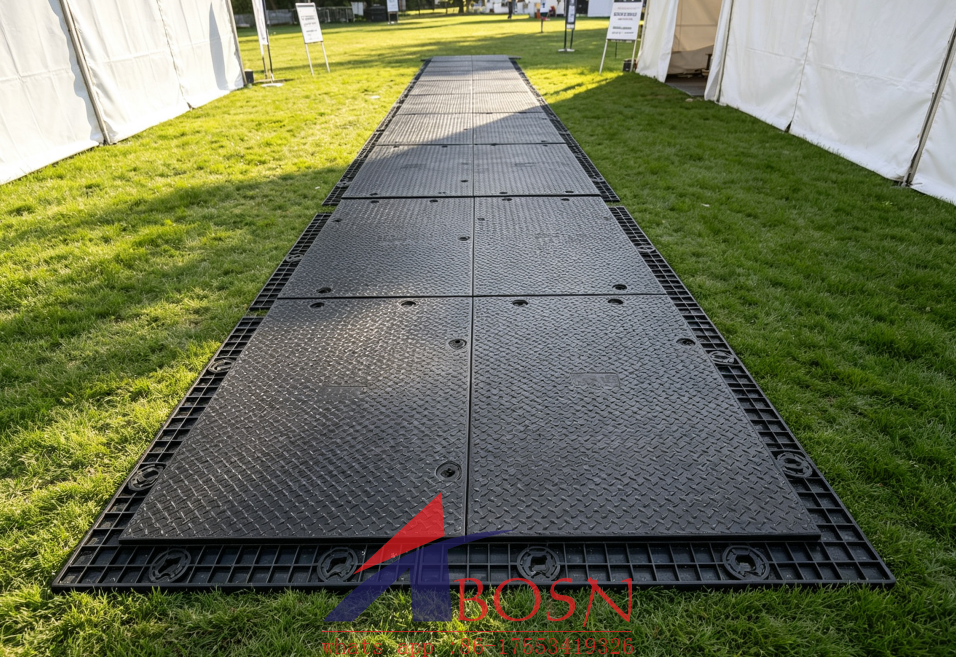
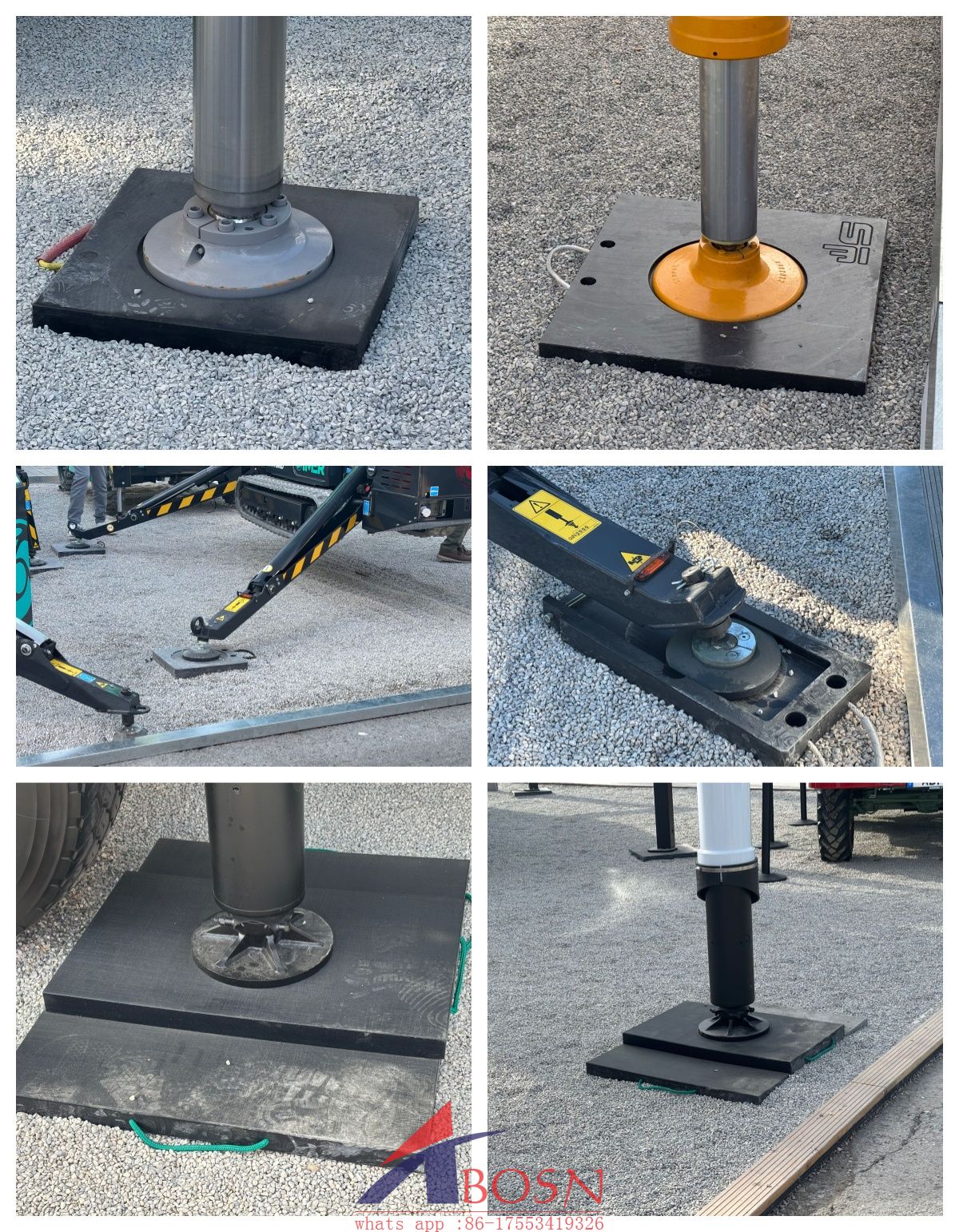
Outrigger pads are critical safety components for equipment with stabilizer legs, such as aerial work platforms, cranes, concrete pump trucks, and mobile cranes. Their primary function is to distribute the enormous concentrated force from the outrigger legs across a larger surface area, preventing the equipment from sinking, cracking the ground surface, or tipping over due to uneven settlement. Choosing the wrong pad can lead to damaged pavement at best, or catastrophic accidents at worst.
This guide breaks down the selection process across different working scenarios.
This is the most common working environment. Equipment operates on hard, level surfaces such as construction site entrances, city roads, factory floors, or parking lots.
Surface Damage: Even on hard surfaces, the concentrated pressure from outriggers (potentially hundreds of kg per cm²) can crack asphalt, fracture concrete, or leave permanent indentations.
Stability Requirements: Outriggers are prone to slipping on hard surfaces, especially when wet or contaminated with oil.
Material: Ultra-High Molecular Weight Polyethylene (UHMW-PE) or high-strength nylon is the top choice. These materials are hard, wear-resistant, and have a high coefficient of friction, providing excellent anti-slip properties while preventing scratches on finished surfaces.
Size: The key factor is load distribution area. The pad must be large enough to keep the ground pressure below the surface's load-bearing capacity.
Formula: Minimum Required Area = Maximum Outrigger Load ÷ Allowable Ground Bearing Pressure
Example: If an outrigger load is 10 tons and the concrete surface allows 30 tons/m², the minimum required area is 0.33 m². This translates to a pad side length of at least 0.57 meters.
Structure: A flat plate design is sufficient. For slightly uneven surfaces, pads with a subtle crown or beveled edges can help prevent edge loading.
Load Capacity: The safe working load (SWL) per pad should be 1.5 to 2 times the maximum outrigger load of the equipment.
Thickness: For standard hard surfaces, a thickness of 25mm to 40mm is sufficient for most applications.
Anti-Slip Design: Look for pads with a textured or embossed top surface. Some pads also feature embedded studs on the bottom for added grip on asphalt.
Using Wood or Steel Plates: Wood rots, splinters, and has unpredictable strength. Steel is extremely slippery, has sharp edges that can damage surfaces and injure personnel, and offers no grip.
Undersized Pads: Choosing pads by "feel" without calculating the required pressure distribution, leading to surface cracking and failure.
Equipment operates on un-compacted natural ground, soft soil, sand, or agricultural fields with low load-bearing capacity. This is the most challenging environment for outrigger pads.
Sinking Risk: The ground has very low bearing capacity. Standard pads can sink rapidly like a knife through butter, causing the equipment to tilt or tip over.
Drainage and Suction: Wet soil or mud can create a suction effect, making the pads extremely difficult to retrieve and causing them to become "stuck."
Material: Multi-layer high-strength plywood or composite sandwich panels are essential. These pads often feature an internal aluminum frame or fiber-reinforced layers. They provide exceptional flexural strength and load capacity with minimal weight, preventing the "bowl effect" (where the pad's center sinks and edges curl up) in soft ground.
Size: Area is king. The goal is to "put big shoes on" to reduce ground pressure to a safe level.
Rule of Thumb: The pad area should be 2 to 4 times larger than what would be used for a standard hard surface. For example, if a 0.3 m² pad works on concrete, you may need at least 1.0 m² on soft soil.
Structure: The pad should be designed to prevent soil intrusion and facilitate easy removal. Look for features like:
Rigid, non-flexing core: To maintain even pressure distribution.
Integrated handles or lifting eyes: For easy attachment and retrieval, especially when the pad is sunk into mud.
Slightly concave or flat bottom: To maximize contact area and resist suction.
Flexural Strength: This is more critical than compressive strength for soft ground. Choose pads with a high modulus of elasticity (stiffness) to resist bending.
Thickness: Typically 50mm to 100mm or more, depending on the span and expected load. Thicker pads provide greater resistance to bending.
Corrosion Resistance: Materials must be resistant to moisture, rot, and chemical degradation from soil.
Using standard UHMW pads: While strong, standard flat pads will often bend or "dome" in soft ground if not thick enough, leading to uneven pressure distribution and sinking.
Ignoring retrieval: Failing to attach a rope or handle to the pad before it sinks into mud, requiring excavation to retrieve it.
Equipment must operate on delicate, finished, or aesthetically important surfaces where preventing cosmetic damage is a top priority. This includes marble floors in atriums, epoxy-coated warehouse floors, polished concrete showrooms, and manicured golf courses or lawns.
Cosmetic Damage: Standard pads can leave scuff marks, rust stains, or deep impressions that ruin expensive finishes.
Surface Indentation: Even with load distribution, soft materials like turf can be permanently damaged by the pressure and heat generated during operation.
Material: Non-marking, soft yet durable materials are required.
For hard, finished floors: Use pads with a rubber or polyurethane top layer or full rubber construction. These provide a high-friction, non-slip, non-marking surface.
For turf or lawns: Use large-area composite or plywood pads specifically designed for turf protection. Some are designed to "float" on the surface to minimize grass compression.
Size: For turf, the goal is to minimize pressure per unit area to the lowest possible level to prevent grass root damage.
Structure: The pad should have a smooth, flat underside with no sharp edges, bolts, or metal protrusions that could scratch or gouge the surface.
Surface Hardness: The contact surface should be softer than the surface being protected (e.g., rubber on marble) to prevent scratching.
Color: Use non-marking black, gray, or neutral-colored pads that won't transfer dye, especially on light-colored or porous surfaces.
Load Distribution: Prioritize maximum surface area over all other factors.
Using metal or uncoated composite pads: These will almost certainly scratch or mark sensitive floors.
Overlooking temperature: Hydraulic outriggers can get hot; using a thin rubber pad alone may not provide adequate insulation for delicate surfaces. A thick, thermally insulating composite pad is a better choice.
Neglecting to clean: Dirt or grit trapped between the pad and a finished floor acts as sandpaper, causing abrasion even with a "soft" pad.
Selecting the correct outrigger pad is not a one-size-fits-all decision. By carefully evaluating your working environment, calculating your equipment's load requirements, and matching the pad's material and size to the specific scenario, you can ensure maximum safety, protect valuable surfaces, and extend the life of your equipment.
Contact joanna@dzabosn.com Whats app 86-17553419326